Healing Journey, Making a Difference, Self-Discovery

Cultivating Gratitude in November — And Beyond

The crisp November air holds a subtle invitation: to pause, inhale deeply, and turn the gaze inward with a heartfelt “thank you.” I am grateful for those who trust me as their mentor, Essential Oil Coach, and Emotion Code, Body Code, and Belief Code Practitioner. I am thankful to those who follow me on the various platforms and hope you find value in what I share. Thank you for joining me on this journey.

As the golden leaves shift into quiet rest, so too can we shift from doing to being grateful. For many years I’ve taken this month to share one daily gratitude post on social media—and this year I’m inviting you to join me. Let’s explore why this matters: the science of gratitude, how it influences our health, and how simple daily practice can ripple into our wellbeing and community.


Why Gratitude Matters: The Research Story

Gratitude is more than a feel-good notion. In psychological science it’s defined as “the appreciation of what is valuable and meaningful to oneself; a general state of thankfulness and/or appreciation” (Wood, Joseph, Lloyd, & Atkins, 2009).

Here are several evidence-based benefits:

1. Mental & Emotional Wellbeing

  • Gratitude correlates with greater happiness, more positive emotions, and improved life satisfaction (Harvard Health, 2021).
  • A meta-analysis of 64 randomized trials found gratitude interventions led to significant improvements in mental health: fewer symptoms of anxiety (−7.8 %) and depression (−6.9 %) (Jans-Beken et al., 2022).
  • Gratitude writing specifically (vs. general expressive writing) decreased stress and negative affect in a one-month follow-up (Schanche et al., 2020).

2. Physical Health & Sleep

  • Gratitude is associated with better sleep quality, reduced fatigue, fewer physical symptoms, and improved cardiovascular markers (Harvard Health, 2024).
  • Individuals with higher dispositional gratitude report greater vitality, less anxiety, and better self-rated physical health (Hill & Roberts, 2011).

3. Brain, Body, and Neural Pathways

  • Neuroscientific work shows gratitude activates brain regions tied to reward, social bonding, and emotional regulation (Fox et al., 2015).
  • Gratitude journaling helps “rewire” the brain—shifting attention toward noticing positives and strengthening social connections (The Resilience Project, 2023).

4. Relationships & Community

  • Gratitude strengthens social ties. Expressing thanks signals that we’ve received value from someone else, fostering trust, connection, and prosocial behavior (Greater Good Science Center, 2016).
  • The ripple extends beyond the individual; by nurturing gratitude, we also nurture environments of appreciation, kindness, and resilience.

How This Matters for You — And for Us Together

As I share my daily “gratitude” posts throughout November with you, here’s what I’m inviting—and what you might discover:

  • Resilience under pressure. Life brings stress, uncertainty, pain—yet research shows gratitude buffers against anxiety, depressive symptoms, and even lowers physical complaints.
  • Foundational self-care. While we often think of self-care as what we do (exercise, essential oils, sleep routines), gratitude is what we become—an orientation, a noticing.
  • Embodied payoff. Better sleep, less fatigue, improved mood—these aren’t extras; they’re foundational to showing up fully in your life, relationships, and purpose.
  • Shared transformation. When you join the daily gratitude practice with me, we create a collective momentum—a shared shift toward noticing, naming, and appreciating the good. That communal energy amplifies the individual benefits.

How to Participate: A Simple Framework

Here’s how you can join in this year’s November gratitude journey—with flexibility built in so it fits you.

  1. Download your free Gratitude Journal. (below)
    Begin by downloading my Beyond Possibilities Gratitude Journal, designed to guide your daily reflections and deepen your awareness of what’s good in your life. It includes space for 3–10 daily gratitude entries, inspiring prompts, and weekly reflection pages. (Download link coming soon!)
  2. Choose your medium.
    Whether it’s your downloaded journal, a digital notes app, or a social-media post—pick the format you’ll stick with.
  3. Keep it manageable.
    Research suggests that recording 3 to 10 items per day tends to produce optimal benefits (more than 10 may dilute impact).
    • For example: “I’m grateful today for…” followed by 3–5 things.
    • You may also pick a theme of the day (health, connection, nature, small joys, acts of kindness).
  4. Be honest & intentional.
    Gratitude doesn’t mean ignoring challenges—it means also noticing what’s good despite them. Authenticity matters more than perfection.
    • A suggested prompt: “What happened today that I might normally overlook—and how did it matter?”
    • Another: “Who made a difference for me today—and how can I thank them?”
  5. Share the ripple.
    Post what you’re grateful for on my daily gratitude post—either on LinkedIn or Facebook.
    Join the conversation, celebrate others’ moments of gratitude, and invite friends or family to participate.
    Or share on your own social media with the hashtag #BeyondGratitude to connect our growing community of thankfulness.
  6. Reflect weekly.
    At the end of each week in November, look back—What patterns emerge? What small things became big? What surprised you? This reflective pause deepens your practice and anchors your learning.

Why This Year Feels Especially Right

Given the fullness of our lives—with our personal healing journeys, essential-oil routines, emotional body work, stress-management, and self-care practices—layering in a gratitude practice is like adding a powerful support beam under the rest of the structure. It doesn’t replace anything you’re doing; it helps everything you do work better.
Plus, once gratitude becomes a habit, its benefits persist and compound over time.


In Closing

I invite you to step into November together—each day noticing something you are grateful for, sharing it if you choose, and inviting others into the circle. Let’s watch how small moments of thanks can build into greater resilience, deeper joy, stronger relationships, and more vibrant health.

With heartfelt thanks for you—for showing up, for choosing healing, for being part of this community. Here’s to a month of gratitude, connection, and transformation.


References

Emmons, R. A., & McCullough, M. E. (2003). Counting blessings versus burdens: An experimental investigation of gratitude and subjective well-being in daily life. Journal of Personality and Social Psychology, 84(2), 377–389.
Fox, G. R., Kaplan, J., Damasio, H., & Damasio, A. (2015). Neural correlates of gratitude. Frontiers in Psychology, 6(1491). https://doi.org/10.3389/fpsyg.2015.01491
Greater Good Science Center. (2016). How gratitude changes you and your brain. https://greatergood.berkeley.edu/article/item/how_gratitude_changes_you_and_your_brain
Harvard Health. (2021). Giving thanks can make you happier. https://www.health.harvard.edu/healthbeat/giving-thanks-can-make-you-happier
Harvard Health. (2024). Gratitude enhances health, brings happiness — and may even lengthen lives. https://www.health.harvard.edu/blog/gratitude-enhances-health-brings-happiness-and-may-even-lengthen-lives-202409113071
Hill, P. L., & Roberts, B. W. (2011). Examining the pathways between gratitude and self-rated physical health. Psychology & Health, 26(9), 1057–1072. https://pmc.ncbi.nlm.nih.gov/articles/PMC3489271/
Jans-Beken, L., et al. (2022). The effects of gratitude interventions: A systematic review and meta-analysis. Frontiers in Psychology. https://pmc.ncbi.nlm.nih.gov/articles/PMC10393216/
Schanche, E., et al. (2020). A brief gratitude writing intervention decreased stress and negative affect. Frontiers in Psychology. https://pmc.ncbi.nlm.nih.gov/articles/PMC8867461/
The Resilience Project. (2023). Gratitude and the benefits of journaling. https://theresilienceproject.com.au/at-home/wellbeing-hub/gratitude-and-the-benefits-of-journaling/
Wood, A. M., Joseph, S., Lloyd, J., & Atkins, S. (2009). Gratitude influences sleep through the mechanism of pre-sleep cognitions. Journal of Psychosomatic Research, 66(1), 43-48.

Energy Healing, Healing Journey, Health, Self-Discovery

Movement and Emotion: The Science of Feeling Through Motion

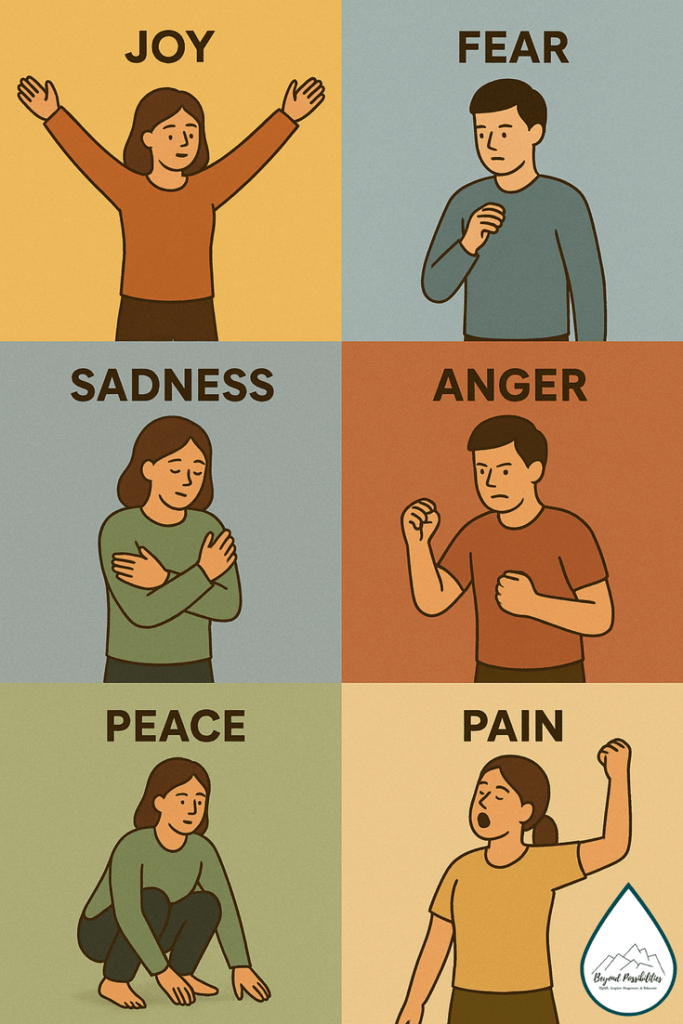
Have you ever noticed how your body naturally moves with your emotions? You bounce when you’re happy, curl in when you’re sad, or tense your shoulders when you’re stressed. These patterns aren’t random — they reflect how the brain and body communicate through posture, physiology, and feeling. Research confirms what movement and healing traditions have long understood: movement changes emotion, and emotion changes movement.

Now, before I go too deep, you don’t have to overthink it. You can work through your emotions by simply putting on your favorite music and letting your body move to the music naturally. I also love doing AromaDance or Mindful Movement to move through my emotions.

The Somatic Basis of Emotion

Emotions aren’t only “in your head.” They’re embodied experiences involving the autonomic nervous system (ANS), muscle tone, breath, and interoception — our inner sense of how our body feels. When emotions are safely expressed through movement, the body can complete its stress cycle and return to balance. Movement therapies and somatic practices (e.g., gentle stretching, dance/movement therapy, rhythmic motion) have demonstrated reductions in cortisol, enhanced emotional regulation, and improvements in psychological well-being (Koch, Morlinghaus, & Fuchs, 2019; Wu, Li, & Zhang, 2023).


Joy: Expand, Express, Energize

Open-arm reach / chest opening
Expanding posture (arms wide, chest lifted) increases lung volume, influences the balance of sympathetic and parasympathetic tone, and signals openness and approach behavior — postures correlated with higher positive affect (e.g. expanded posture studies).

Light bounce / small hops
Gentle vertical bouncing raises endorphins and dopamine and stimulates spinal and vestibular systems for autonomic regulation.

Playful skipping / side-step
Rhythmic side-to-side locomotion with arm swing boosts mood, supports motor coordination, and taps into play systems.

Wiggle / spontaneous dance
Free, irregular movement (hips, torso, shoulders) enhances body awareness (interoception), modulates autonomic tone, and can increase positive affect (Koch et al., 2019).

Shake / tremor (gentle, spontaneous)
Small tremors or shakes help discharge stored motor tension and reduce autonomic hyperarousal, as in trauma-release (TRE) approaches.

Roll (gentle floor roll → stand)
Rolling shifts vestibular input and proprioceptive orientation, helping interrupt stuck tension patterns and inviting fluidity in the body.


Fear & Anxiety: Grounding, Soothing, Calming

Tap / hum
Gentle tapping or humming engages vagal pathways (via vibration) and supports parasympathetic activation, helping calm high arousal states.

Squeeze / hold (self-hug)
Applying gentle compression through a self-hug or forearm hold reduces cortisol and signals safety through proprioceptive feedback.

Sway / reach
Slow pendular motion with gentle arm reach soothes the vestibular system and offers predictable sensory input, helping regulate hyperarousal.


Sadness / Grief / Shame: Nurturing, Soothing, Softening

Brush / self-hug (gentle stroking)
Slow, affective touch activates C-tactile afferents associated with oxytocin release and supports calming networks.

Rock / squeeze (gentle rocking)
Rocking or gentle compressive movement engages vestibular regulatory systems, offering a soothing rhythm and containment for emotional processing.


Anger / Frustration: Safe Release, Grounding Power

Tense → release (clench / relax)
Voluntary muscle contraction followed by release modulates muscle spindle activity and helps the nervous system downregulate from tension.

Stomp / ground (foot strike)
Energetic foot strikes provide strong proprioceptive feedback and anchor excess energy into the ground, giving a sense of boundary.

Slam / push (controlled directional force)
Using controlled push or strike against a safe surface (e.g., wall, pillow) enables expression of force while reducing internal pressure and reactivity.


Peace / Calm / Confidence: Stabilizing & Centering

Ground / connect (rooted stance)
Soft squats, weight awareness in feet/ankles, and slow shifts help reestablish bodily stability and downregulate sympathetic tone.

Rest / restorative posture
Lying down with deep, diaphragmatic breathing stimulates the vagus nerve and promotes parasympathetic recovery.

Center / mindful micro-movement
Very gentle motions (neck rolls, shoulder circles) enhance interoceptive clarity and soothe the system, supporting self-regulation.


Pain / Fatigue / Recovery: Soothing, Flowing, Releasing

Settle / breathe (long exhale + micro shifts)
Slow, extended exhales paired with small posture adjustments relieve muscle guarding and support relaxation.

Ground / connect (light motion)
Gentle walking or standing awareness improves circulation and sensory grounding — beneficial for fatigue and mild pain.

Stretch / yawn / gentle mobilization
Stretching or yawning modulates muscle spindle feedback and encourages relaxation and renewed energy.


Why Somatic Movement Works

  • Interoception & emotional regulation: Improving body awareness strengthens emotion regulation capacity.
  • Rhythm & vestibular input: Repetitive movements (sway, rock, bounce) help regulate the autonomic nervous system.
  • Vocal + breath stimulation: Humming, sighing, and extended exhalation activate vagal pathways.
  • Free movement & dance: Encourages fluidity, creativity, and improved affect regulation (Koch et al., 2019; Wu et al., 2023).

Final Thoughts

Our feelings naturally manifest in the body. By intentionally choosing movement that mirrors or completes those expressions, we can help the body return to balance. Whether it’s a joyful stretch, a grounding stomp, or a slow restorative breath, each movement is a doorway to recalibration and liberation.


References

Dreisörner, A., & Junker, N. M. (2022). Self-soothing touch and being hugged reduce cortisol responses to stress: A randomized controlled trial on stress, physical touch, and social identity. Journal of Psychosomatic Research, 157, 110847. https://doi.org/10.1016/j.jpsychores.2022.110847

Eckstein, M., Kämmerer, D., Knafo, S., & Heinrichs, M. (2020). Calming effects of touch in human, animal, and robotic social interactions. Frontiers in Psychiatry, 11, Article 567. https://www.ncbi.nlm.nih.gov/pmc/articles/PMC7672023/

Koch, S. C., Morlinghaus, K., & Fuchs, T. (2019). Effects of dance/movement therapy and dance on health-related psychological outcomes: A meta-analysis. Frontiers in Psychology, 10, Article 1806. https://www.frontiersin.org/articles/10.3389/fpsyg.2019.01806/full

Lindgren, L. (2012). Emotional and physiological responses to touch massage (Doctoral dissertation, Umeå University). Umeå University Repository. https://www.diva-portal.org/smash/get/diva2%3A568111/fulltext01.pdf

Packheiser, J., et al. (2024). A systematic review and multivariate meta-analysis of touch interventions: Effects on cortisol, pain, anxiety, and more. Nature Human Behaviour. https://www.nature.com/articles/s41562-024-01841-8

Wu, J., Li, Y., & Zhang, T. (2023). Effects of dance movement interventions on psychological health in older adults: A meta-analysis and systematic review. Brain Sciences, 13(7), 981. https://www.mdpi.com/2076-3425/13/7/981

Grief
Energy Healing, Essential Oils, Healing Journey, Health, Self-Discovery

Honoring Your Emotions Through Trauma: Natural Pathways for Healing and Resilience

Grief, loss, and life’s hardest traumas can feel overwhelming, leaving the heart heavy and the mind clouded. During these times, it’s not about pushing emotions away but learning how to honor and process them. By combining natural approaches—such as breathwork, journaling, meditation, energy healing, and aromatherapy—we can create supportive spaces for healing. These practices, rooted in both tradition and research, help release what weighs us down while building emotional resilience.


Energy Healing for Emotional Release

Many people hold unresolved emotions in the body, leading to stress, pain, and imbalance. Energy healing techniques like the Emotion Code, Body Code, and Belief Code are designed to release these emotional burdens.

  • Emotion Code focuses on identifying and clearing trapped emotions that may contribute to anxiety, sadness, or tension. In a study with 146 participants, significant reductions in self-reported depression, anxiety, and PTSD symptoms were observed after sessions with this modality, though more controlled research is needed (Gelb et al., 2021).
  • Body Code expands this approach to include physical, energetic, and structural imbalances that can affect overall wellness.
  • Belief Code addresses limiting subconscious beliefs that may keep people stuck in cycles of grief or pain. Once emotional barriers are released, healthier thought patterns can emerge.

While scientific validation continues to grow, these approaches align with widely accepted psychological concepts of mind-body connection and the importance of processing emotions rather than storing them internally (Bucci, 2025).

Unlock the Secrets to Lasting Emotional Wellness in Just a Few Days & Transform Your Life by Joining the Immersion Path.


Natural Tools for Emotional Healing

Breathwork

Breathwork helps regulate the nervous system and calm emotional reactivity. By slowing and deepening the breath, the body shifts from a fight-or-flight state into a calmer, more restorative mode.

Journaling

Writing out feelings provides clarity and helps organize overwhelming emotions. Journaling offers a safe space to name experiences, uncover insights, and begin reframing grief into meaning.

Meditation

Meditation practices—whether focused attention, mindfulness, or loving-kindness—help reduce distress and promote emotional stability. Neuroimaging studies show that meditation activates brain regions linked to empathy and regulation, such as the insula and anterior cingulate cortex (Fox et al., 2016).


Aromatherapy with doTERRA CPTG® Essential Oils*

Scent has a direct influence on the limbic system, the part of the brain that governs emotions and memories. Using doTERRA Certified Pure Tested Grade (CPTG®) essential oils can provide powerful emotional support during times of grief:

  • Console® Comforting Blend (Rose, Ylang Ylang, Frankincense, Sandalwood) offers calming, balancing support when sadness feels heavy.
  • Forgive® Renewing Blend (Nootka Tree, Thyme, Melissa) encourages self-compassion and renewal during emotional recovery.
  • Cheer® Uplifting Blend (Wild Orange, Cinnamon Bark, Star Anise) sparks optimism and helps shift lingering gloom.
  • Bergamot Essential Oil has shown promise in reducing PTSD-related symptoms such as sleep disruption and negative mood in first responders (Daniel, 2023).
  • Lime Essential Oil has been shown to imbue the soul with a zest for life and promotes courage. It is renewing, energizing and purify. Paired with other oils it magnifies their effect.
  • Balance® Grounding Blend The warm, woody aroma of doTERRA Balance Grounding Blend helps create a calming, quieting environment as you consider all aspects of life: relationships, work, fitness, health, and emotional well-being.
  • Peace® Reassuming Blend A gentle blend of floral and mint oils, doTERRA Peace Reassuring Blend serves as a positive reminder that you don’t have to be perfect to find peace.

From a biochemical perspective, compounds like linalool (Lavender, Clary Sage) and beta-pinene (Lemon, Lime, White Fir) interact with neurotransmitter systems linked to serotonin and dopamine, potentially easing anxious or sad feelings (doTERRA, n.d.-b).

While results vary, aromatherapy remains a gentle, non-invasive complement to emotional healing practices. Safety should always be prioritized, including dilution for topical use and sourcing oils from reputable providers such as doTERRA (Johns Hopkins Medicine, 2024).


Bringing It All Together

Honoring emotions during grief and trauma means allowing space for release, reflection, and renewal. Breathwork, journaling, meditation, energy healing, and essential oils each offer unique pathways toward peace. Together, they create a holistic framework for processing heavy feelings while building resilience for the road ahead.

Healing is not about forgetting loss—it’s about finding light in the darkness and carrying forward with strength and compassion.


*These statements have not been evaluated by the Food and Drug Administration. This product is not intended to diagnose, treat, cure, or prevent any disease.


References

Self-Discovery

The Science of Setting Achievable Goals: 5 Steps to Success

Setting goals isn’t just about writing a list—it’s about aligning your vision, emotions, and daily actions in a way that makes success possible. Research shows that people who set clear, structured goals are far more likely to achieve them (Locke & Latham, 2002). But goals are not only mental exercises—they are also deeply emotional and spiritual journeys. Inviting God into the process through prayer and trust transforms goals from “tasks to accomplish” into opportunities for growth and grace.

Why Positive Feelings Matter in Goal Achievement

Studies in psychology show that positive emotions broaden attention, increase motivation, and build resilience (Fredrickson, 2001). When you feel good about your progress—even small wins—your brain releases dopamine, reinforcing the behavior and encouraging you to keep going (Kringelbach & Berridge, 2016).

One powerful way to strengthen positive emotions is through gratitude. Thank God for every step you take toward your goal, no matter how small. Gratitude isn’t only about what you’ve already received—it’s about appreciating the journey as you walk it.

Another key practice is to visualize what achieving your goal will feel like. Imagine the peace, joy, or confidence you’ll have when you reach it. Studies show that vividly describing these positive feelings increases persistence and success (Pham & Taylor, 1999). Combining gratitude with visualization keeps your spirit lifted and focused.

SMART Goals: The Key to Clarity

One of the most effective frameworks for goal-setting is the SMART model:

  • Specific – A clear, well-defined goal (e.g., “Walk 30 minutes, 5 days a week” vs. “Exercise more”).
  • Measurable – A way to track progress (time, frequency, or other metrics).
  • Achievable – Realistic given your current resources and lifestyle.
  • Relevant – Aligned with your values, faith, and long-term objectives.
  • Time-bound – A deadline or timeline to create urgency and accountability.

Research confirms that specific and measurable goals are more likely to be achieved than vague intentions (Locke & Latham, 2002).

5 Steps to Achieving Your Goals

1. Define Your Goal with Clarity and Prayer

Write it down in SMART format. For example, instead of “I want to be healthier,” say:
“I will walk for 30 minutes, 5 days a week, for the next 3 months.”

Then, take your goal to God in prayer. Ask for wisdom, strength, and discernment. Proverbs 16:3 reminds us: “Commit to the Lord whatever you do, and He will establish your plans.”

2. Break It into Manageable Milestones

Large goals can feel overwhelming. Breaking them into smaller steps makes them more achievable and provides built-in opportunities to celebrate progress. Each milestone is also a moment to pause, give thanks, and pray for guidance on the next step.

3. Harness Positive Emotions, Gratitude, and Faith

Celebrate small wins, keep a gratitude journal, and thank God as you move forward. Gratitude enhances motivation and strengthens resilience (Emmons & McCullough, 2003).

As you go, imagine what it will feel like to achieve your goal—the joy, peace, or sense of accomplishment. Ask God to keep that vision alive in your heart and to help you persevere.

4. Anticipate Obstacles and Plan Ahead with God’s Help

Setbacks are normal. Create “if-then” plans:
“If it rains and I can’t walk outside, then I will do a 20-minute indoor workout.”
Studies show that implementation intentions like this significantly improve success rates (Gollwitzer, 1999). But also remember—when obstacles come, prayer can shift your perspective. Philippians 4:13 says: “I can do all things through Christ who strengthens me.”

5. Review, Adjust, and Stay Connected Spiritually

Goals are not static. Reflect weekly or monthly on your progress. If your original plan isn’t working, adapt it. Flexibility increases the likelihood of long-term achievement (Sheldon & Elliot, 1999).

At each checkpoint, take time to pray—celebrating what’s working and seeking guidance on what to adjust. This keeps your goals in alignment with both your values and God’s plan for your life.

The Power of Goal Journaling

Keeping a journal of your goals and the steps you take toward them can significantly increase your chances of success. Writing down progress not only makes goals feel more concrete but also provides a space for reflection, gratitude, and prayer along the way. Research shows that tracking progress improves accountability and persistence (Baumeister & Tierney, 2011). A journal also allows you to record challenges and how you overcame them, creating a roadmap you can return to for encouragement. By documenting both milestones and emotions, you reinforce your commitment and stay motivated for the long term.

Final Thoughts

Achieving your goals is not just about willpower—it’s about working with your brain, your emotions, and your faith. By setting clear, measurable goals, expressing gratitude along the way, visualizing what success feels like, and inviting God into every step, you’ll be far more likely to stay the course and experience real, lasting change.


References

Baumeister, R. F., & Tierney, J. (2011). Willpower: Rediscovering the greatest human strength. New York, NY: Penguin Press.

Deci, E. L., & Ryan, R. M. (2000). Self-determination theory and the facilitation of intrinsic motivation, social development, and well-being. American Psychologist, 55(1), 68–78. https://doi.org/10.1037/0003-066X.55.1.68

Emmons, R. A., & McCullough, M. E. (2003). Counting blessings versus burdens: An experimental investigation of gratitude and subjective well-being in daily life. Journal of Personality and Social Psychology, 84(2), 377–389. https://doi.org/10.1037/0022-3514.84.2.377

Fredrickson, B. L. (2001). The role of positive emotions in positive psychology: The broaden-and-build theory of positive emotions. American Psychologist, 56(3), 218–226. https://doi.org/10.1037/0003-066X.56.3.218

Gollwitzer, P. M. (1999). Implementation intentions: Strong effects of simple plans. American Psychologist, 54(7), 493–503. https://doi.org/10.1037/0003-066X.54.7.493

Kringelbach, M. L., & Berridge, K. C. (2016). The neuroscience of happiness and pleasure. Social Research, 80(2), 385–406. https://www.jstor.org/stable/24385609

Locke, E. A., & Latham, G. P. (2002). Building a practically useful theory of goal setting and task motivation: A 35-year odyssey. American Psychologist, 57(9), 705–717. https://doi.org/10.1037/0003-066X.57.9.705

Pham, L. B., & Taylor, S. E. (1999). From thought to action: Effects of process- versus outcome-based mental simulations on performance. Personality and Social Psychology Bulletin, 25(2), 250–260. https://doi.org/10.1177/0146167299025002010

Sheldon, K. M., & Elliot, A. J. (1999). Goal striving, need satisfaction, and longitudinal well-being: The self-concordance model. Journal of Personality and Social Psychology, 76(3), 482–497. https://doi.org/10.1037/0022-3514.76.3.482

Energy Healing, Self-Discovery

What Do You Really Need Right Now? A Path to Rest, Regeneration, and Renewal

Life doesn’t pause. But you can.

We’re often told to “rest” when we’re overwhelmed. But rest is not one-size-fits-all—and it’s certainly not limited to a nap or a weekend off. True self-care begins when we learn how to listen: not just to the noise of the world around us, but to the whispers within.

There are many types of rest—seven, in fact. Each one speaks to a different dimension of our being: physical, emotional, mental, sensory, social, creative, and spiritual. Understanding which kind of rest you truly need is the beginning of deep self-care and regeneration.

If you’re feeling drained and unsure why—this post is for you.

Let’s explore how you can reconnect with your whole self and discover what you really need to feel nourished, restored, and alive.


7 Types of Rest: A Brief Reflection

  1. Physical Rest – Your body asks for stillness. This might mean sleep, stretching, or a walk.
  2. Emotional Rest – Your heart longs to release. Self-care, boundary-setting, and journaling help here.
  3. Mental Rest – Your mind seeks space. Take a break, play with puzzles, practice mindfulness.
  4. Sensory Rest – Your senses crave quiet. Step away from screens, be in nature, enjoy a book.
  5. Social Rest – Your soul needs connection—or solitude. Spend time with loved ones or simply be alone.
  6. Creative Rest – Your spirit yearns to express. Paint, write, explore something new.
  7. Spiritual Rest – Your inner self calls for meaning. Meditate, reflect, and reconnect.

Guided Meditation: Tuning Into Your True Needs

Find a quiet space where you won’t be disturbed. Sit or lie down comfortably. Let this be a sacred moment for yourself.


After the Meditation: Journal for Inner Discovery

Take a few moments now to write freely. Download the workbook and let these prompts guide you into deeper self-awareness.


    Beyond Rest: Toward Regeneration

    Rest is not a reward for burnout. It is your birthright.

    When you rest with awareness—when you ask your inner self what you need and respond with love—you begin to regenerate. Not just physically, but energetically, emotionally, and spiritually.

    This is the heart of self-care. Not a checklist, but a relationship—with yourself.

    So today, give yourself permission to pause. Tune in. And respond.

    There is wisdom within you. It’s been waiting patiently for your attention.


    You don’t need to do more. You need to feel more. Be more. Trust more.

    Welcome back to yourself.