Energy Healing, Healing Journey, Health, Self-Discovery

Movement and Emotion: The Science of Feeling Through Motion

Have you ever noticed how your body naturally moves with your emotions? You bounce when you’re happy, curl in when you’re sad, or tense your shoulders when you’re stressed. These patterns aren’t random — they reflect how the brain and body communicate through posture, physiology, and feeling. Research confirms what movement and healing traditions have long understood: movement changes emotion, and emotion changes movement.

Now, before I go too deep, you don’t have to overthink it. You can work through your emotions by simply putting on your favorite music and letting your body move to the music naturally. I also love doing AromaDance or Mindful Movement to move through my emotions.

The Somatic Basis of Emotion

Emotions aren’t only “in your head.” They’re embodied experiences involving the autonomic nervous system (ANS), muscle tone, breath, and interoception — our inner sense of how our body feels. When emotions are safely expressed through movement, the body can complete its stress cycle and return to balance. Movement therapies and somatic practices (e.g., gentle stretching, dance/movement therapy, rhythmic motion) have demonstrated reductions in cortisol, enhanced emotional regulation, and improvements in psychological well-being (Koch, Morlinghaus, & Fuchs, 2019; Wu, Li, & Zhang, 2023).
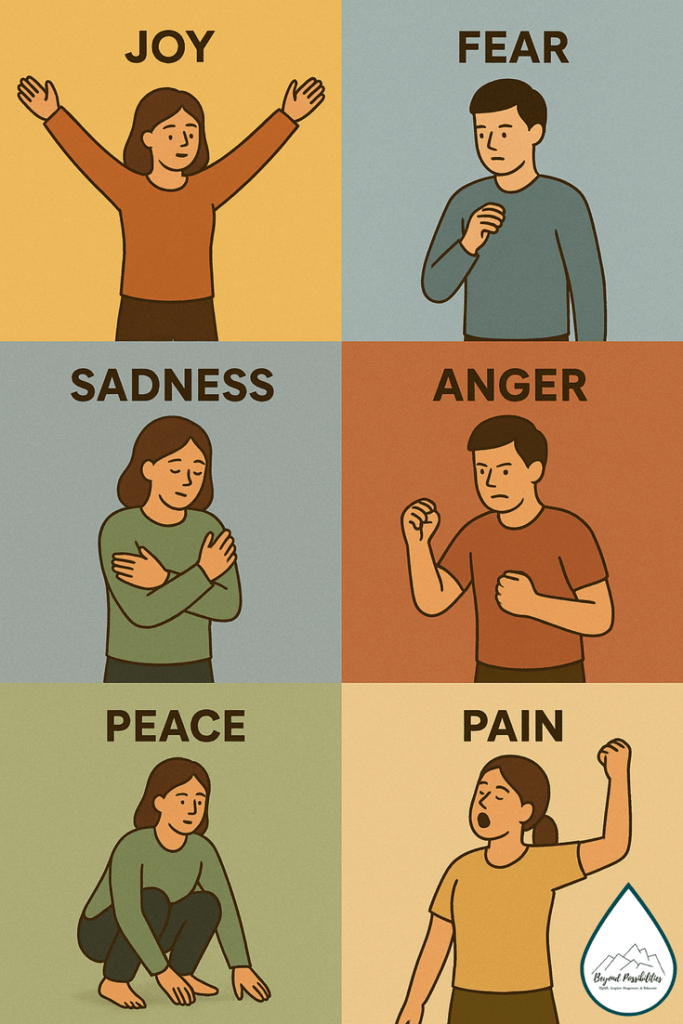


Joy: Expand, Express, Energize

Open-arm reach / chest opening
Expanding posture (arms wide, chest lifted) increases lung volume, influences the balance of sympathetic and parasympathetic tone, and signals openness and approach behavior — postures correlated with higher positive affect (e.g. expanded posture studies).

Light bounce / small hops
Gentle vertical bouncing raises endorphins and dopamine and stimulates spinal and vestibular systems for autonomic regulation.

Playful skipping / side-step
Rhythmic side-to-side locomotion with arm swing boosts mood, supports motor coordination, and taps into play systems.

Wiggle / spontaneous dance
Free, irregular movement (hips, torso, shoulders) enhances body awareness (interoception), modulates autonomic tone, and can increase positive affect (Koch et al., 2019).

Shake / tremor (gentle, spontaneous)
Small tremors or shakes help discharge stored motor tension and reduce autonomic hyperarousal, as in trauma-release (TRE) approaches.

Roll (gentle floor roll → stand)
Rolling shifts vestibular input and proprioceptive orientation, helping interrupt stuck tension patterns and inviting fluidity in the body.


Fear & Anxiety: Grounding, Soothing, Calming

Tap / hum
Gentle tapping or humming engages vagal pathways (via vibration) and supports parasympathetic activation, helping calm high arousal states.

Squeeze / hold (self-hug)
Applying gentle compression through a self-hug or forearm hold reduces cortisol and signals safety through proprioceptive feedback.

Sway / reach
Slow pendular motion with gentle arm reach soothes the vestibular system and offers predictable sensory input, helping regulate hyperarousal.


Sadness / Grief / Shame: Nurturing, Soothing, Softening

Brush / self-hug (gentle stroking)
Slow, affective touch activates C-tactile afferents associated with oxytocin release and supports calming networks.

Rock / squeeze (gentle rocking)
Rocking or gentle compressive movement engages vestibular regulatory systems, offering a soothing rhythm and containment for emotional processing.


Anger / Frustration: Safe Release, Grounding Power

Tense → release (clench / relax)
Voluntary muscle contraction followed by release modulates muscle spindle activity and helps the nervous system downregulate from tension.

Stomp / ground (foot strike)
Energetic foot strikes provide strong proprioceptive feedback and anchor excess energy into the ground, giving a sense of boundary.

Slam / push (controlled directional force)
Using controlled push or strike against a safe surface (e.g., wall, pillow) enables expression of force while reducing internal pressure and reactivity.


Peace / Calm / Confidence: Stabilizing & Centering

Ground / connect (rooted stance)
Soft squats, weight awareness in feet/ankles, and slow shifts help reestablish bodily stability and downregulate sympathetic tone.

Rest / restorative posture
Lying down with deep, diaphragmatic breathing stimulates the vagus nerve and promotes parasympathetic recovery.

Center / mindful micro-movement
Very gentle motions (neck rolls, shoulder circles) enhance interoceptive clarity and soothe the system, supporting self-regulation.


Pain / Fatigue / Recovery: Soothing, Flowing, Releasing

Settle / breathe (long exhale + micro shifts)
Slow, extended exhales paired with small posture adjustments relieve muscle guarding and support relaxation.

Ground / connect (light motion)
Gentle walking or standing awareness improves circulation and sensory grounding — beneficial for fatigue and mild pain.

Stretch / yawn / gentle mobilization
Stretching or yawning modulates muscle spindle feedback and encourages relaxation and renewed energy.


Why Somatic Movement Works

  • Interoception & emotional regulation: Improving body awareness strengthens emotion regulation capacity.
  • Rhythm & vestibular input: Repetitive movements (sway, rock, bounce) help regulate the autonomic nervous system.
  • Vocal + breath stimulation: Humming, sighing, and extended exhalation activate vagal pathways.
  • Free movement & dance: Encourages fluidity, creativity, and improved affect regulation (Koch et al., 2019; Wu et al., 2023).

Final Thoughts

Our feelings naturally manifest in the body. By intentionally choosing movement that mirrors or completes those expressions, we can help the body return to balance. Whether it’s a joyful stretch, a grounding stomp, or a slow restorative breath, each movement is a doorway to recalibration and liberation.


References

Dreisörner, A., & Junker, N. M. (2022). Self-soothing touch and being hugged reduce cortisol responses to stress: A randomized controlled trial on stress, physical touch, and social identity. Journal of Psychosomatic Research, 157, 110847. https://doi.org/10.1016/j.jpsychores.2022.110847

Eckstein, M., Kämmerer, D., Knafo, S., & Heinrichs, M. (2020). Calming effects of touch in human, animal, and robotic social interactions. Frontiers in Psychiatry, 11, Article 567. https://www.ncbi.nlm.nih.gov/pmc/articles/PMC7672023/

Koch, S. C., Morlinghaus, K., & Fuchs, T. (2019). Effects of dance/movement therapy and dance on health-related psychological outcomes: A meta-analysis. Frontiers in Psychology, 10, Article 1806. https://www.frontiersin.org/articles/10.3389/fpsyg.2019.01806/full

Lindgren, L. (2012). Emotional and physiological responses to touch massage (Doctoral dissertation, Umeå University). Umeå University Repository. https://www.diva-portal.org/smash/get/diva2%3A568111/fulltext01.pdf

Packheiser, J., et al. (2024). A systematic review and multivariate meta-analysis of touch interventions: Effects on cortisol, pain, anxiety, and more. Nature Human Behaviour. https://www.nature.com/articles/s41562-024-01841-8

Wu, J., Li, Y., & Zhang, T. (2023). Effects of dance movement interventions on psychological health in older adults: A meta-analysis and systematic review. Brain Sciences, 13(7), 981. https://www.mdpi.com/2076-3425/13/7/981

Health

Moving Your Body at Any Level: 10 Free & Fun Ways to Get Active

When you think about exercise, do you picture intense gym sessions or expensive fitness classes? If so, you’re not alone — but the truth is, movement doesn’t have to cost a thing or look any certain way to benefit your body and mind.

Research consistently shows that movement at any level supports better physical health, emotional well-being, and even helps manage chronic conditions (Booth et al., 2017). And here’s the best part — it doesn’t have to be hard, or boring, or feel like a chore. Movement can be playful, creative, and joyful.

If you’re ready to explore simple, fun ways to move your body (no matter where you’re starting from), this guide is for you.


Movement Benefits Everyone — No Matter Your Fitness Level

Whether you’re just beginning to reconnect with your body or you already move regularly, the science is clear: all movement counts. Consistent physical activity — adapted to your abilities and preferences — can:

  • 🧘‍♀️ Lower stress and anxiety (Stubbs et al., 2018)
  • ❤️ Support heart health and circulation (Warburton & Bredin, 2017)
  • 💪 Improve blood sugar regulation and metabolic health (Bird & Hawley, 2017)
  • 🧠 Boost mood, energy, and cognitive function (Mandolesi et al., 2018)
  • 😴 Enhance sleep quality (Kredlow et al., 2015)
  • 🦠 Strengthen immune function and lower inflammation (Dimeo, 2019)

The beauty of movement? There’s no “right” way to do it. Your body, your preferences, and your unique circumstances all matter — and they deserve to be honored.


10 Free & Fun Ways to Move Your Body

You don’t need fancy gear, apps, or memberships to get more movement into your day. Sometimes, the simplest (and most joyful!) options are completely free. Whether you have 2 minutes or 20, here are 10 creative ways to move your body — without spending a dime.

1. Dance Like Nobody’s Watching

Turn up your favorite playlist and dance it out in your living room, kitchen, or even your backyard. Dancing gets your heart pumping, your body moving, and your mood soaring.

2. Take a Nature Walk

Whether it’s a stroll around the block or a wander through a local park, walking is accessible, adaptable, and proven to support mental and physical health (Shanahan et al., 2016).

3. Staircase Cardio Breaks

If you have access to stairs, you have a built-in workout. Walk, jog, or lunge your way up and down — even for a few minutes — and feel the difference.

4. Bodyweight Mini-Workouts

Push-ups against the wall, squats, calf raises, or gentle stretches — your own body weight is the perfect (and free!) resistance tool.

5. Garden, Rake, or Weed

Yard work is sneakily active! All that bending, digging, and lifting adds up to functional movement that strengthens your muscles and keeps you moving.

6. Stretch It Out

Take 5 minutes to stretch out tight muscles. Stretching helps with flexibility, circulation, and body awareness — and it’s completely free.

7. Neighborhood Scavenger Hunt

Make movement a game! Create a list of things to spot (a red door, a squirrel, a flower), and set off to find them. It’s a playful way to add steps to your day.

8. DIY Obstacle Course

Got kids (or just love to play)? Set up a living room or backyard obstacle course using pillows, furniture, or outdoor items. Crawl, jump, balance, and have fun!

9. Free Online Movement Classes

YouTube has thousands of free movement options — from yoga and tai chi to dance breaks and beginner workouts. Explore until you find a guide you love.

10. Silent Outdoor Dance Parties

Put in your headphones, head to a quiet outdoor spot (or even your backyard), and dance it out under the sky. Playful, liberating, and totally free.


Start Where You Are — Every Step Counts

At Beyond Possibilities, we believe movement is a gift, not a punishment. It’s a chance to reconnect with your body, release stress, and even experience joy. Whether you move for 5 minutes or 50, every bit of compassionate movement counts — no perfection required.

What would happen if you gave yourself permission to move in ways that feel good? What if movement became a form of self-care — instead of something on your to-do list? That’s the invitation. Start small. Stay curious. Celebrate every step.


The more you know…

Prolonged sitting is linked to a higher risk of mortality from all causes and cardiovascular disease, even for those who get enough physical activity, with studies showing a 16% and 34% increased risk, respectively. 

Here’s a breakdown of the health risks associated with excessive sitting:

Increased Risk of Mortality:

  • All-cause mortality:Studies have shown that people who predominantly sit at work have a 16% higher risk of dying from any cause. 
  • Cardiovascular disease mortality:The same studies indicate a 34% higher risk of dying from cardiovascular disease in those who sit for long periods. 
  • Other studies:One study found that prolonged leisure time sitting was associated with a 19% higher rate of death from all causes combined compared to sitting less than 3 hours per day. 

Other Health Risks:

  • Metabolic Dysfunction:Prolonged sitting can lead to metabolic dysfunction, characterized by elevated blood triglyceride levels, reduced HDL-cholesterol levels, and diminished insulin sensitivity. 
  • Increased Risk of Chronic Diseases:Sitting for extended periods is linked to an increased risk of chronic diseases, including obesity, diabetes, and cardiovascular disease. 
  • Back Pain and Musculoskeletal Issues:Prolonged sitting can put a strain on the back, neck, arms, and legs, potentially leading to back pain and other musculoskeletal issues. 
  • Digestive Problems:A sedentary lifestyle, including prolonged sitting, can negatively impact bowel function and may be linked to inflammatory bowel disease and other digestive problems. 
  • Mental Health:Prolonged sitting can also have an impact on mental health, as it is linked to decreased physical activity which can negatively impact mental well-being. 

A recent study asks the question, “What are the health outcomes associated with prolonged occupational sitting in the context of various levels of physical activity among apparently healthy individuals?” (Gao et al., 2024)

Read the study now.


References (APA 7)

Bird, S. R., & Hawley, J. A. (2017). Exercise and type 2 diabetes: New prescription for an old problem. Maturitas, 100, 11-16. https://doi.org/10.1016/j.maturitas.2017.03.022

Booth, F. W., Roberts, C. K., & Laye, M. J. (2017). Lack of exercise is a major cause of chronic diseases. Comprehensive Physiology, 2(2), 1143-1211. https://doi.org/10.1002/cphy.c110025

Dimeo, F. (2019). Effects of exercise on the immune system and outcomes in patients with cancer. Physical Activity and Cancer, 89-106. https://doi.org/10.1007/978-3-319-64337-9_5

Gao, W., Sanna, M., Chen, Y.-H., Tsai, M.-K., & Wen, C.-P. (2024). Occupational Sitting Time, Leisure Physical Activity, and All-Cause and Cardiovascular Disease Mortality. JAMA Network Open7(1), e2350680. https://doi.org/10.1001/jamanetworkopen.2023.50680

Kredlow, M. A., Capozzoli, M. C., Hearon, B. A., Calkins, A. W., & Otto, M. W. (2015). The effects of physical activity on sleep: A meta-analytic review. Journal of Behavioral Medicine, 38(3), 427-449. https://doi.org/10.1007/s10865-015-9617-6

Mandolesi, L., Polverino, A., Montuori, S., Foti, F., Ferraioli, G., Sorrentino, P., & Sorrentino, G. (2018). Effects of physical exercise on cognitive functioning and wellbeing: Biological and psychological benefits. Frontiers in Psychology, 9, 509. https://doi.org/10.3389/fpsyg.2018.00509

Rhodes, R. E., McEwan, D., & Rebar, A. L. (2017). Theories of physical activity behaviour change: A history and synthesis of approaches. Psychology of Sport and Exercise, 42, 100-109. https://doi.org/10.1016/j.psychsport.2018.11.010

Shanahan, D. F., Franco, L., Lin, B. B., Gaston, K. J., & Fuller, R. A. (2016). The benefits of natural environments for physical activity. Sports Medicine, 46(7), 989-995. https://doi.org/10.1007/s40279-016-0502-4

Stubbs, B., Vancampfort, D., Rosenbaum, S., Firth, J., Cosco, T., Veronese, N., … & Schuch, F. B. (2018). An examination of the anxiolytic effects of exercise for people with anxiety and stress-related disorders: A meta-analysis. Psychiatry Research, 258, 136-140. https://doi.org/10.1016/j.psychres.2017.11.020

Warburton, D. E., & Bredin, S. S. (2017). Health benefits of physical activity: A systematic review of current systematic reviews. Current Opinion in Cardiology, 32(5), 541-556. https://doi.org/10.1097/HCO.0000000000000437

⚠DISCLAIMER⚠ All media content created by Beyond Possibilities and the AromaVibe is intended for education purposes only. *These statements have not been evaluated by the Food and Drug Administration. This is not intended to diagnose, treat, cure, or prevent any disease.

Uncategorized

Music, Movement, and Mood – Just Dance

I have always loved to crank up the music when I am in the car by myself. A few weeks ago my husband cranked up the music while we were working around the house. What I noticed was a shift in the mood. We all sang along with the music and moved to the beat was we completed our tasks.

Since then I have been exploring how music and movement can improve my mood. One of the things I discovered is that when I am sitting at my desk working, my energy seems to drain. When I add upbeat music, I feel more energized. Even better if I get up and dance, I can return to my tasks and be more productive.

Our bodies are meant to move

“In less than two generations, physical activity has dropped by 20% in the U.K. and 32% in the U.S. In China, the drop is 45% in less than one generation. Vehicles, machines and technology now do our moving for us. What we do in our leisure time doesn’t come close to making up for what we’ve lost” – designedtomove.org

Movement affects every aspect of our physical and emotional health. It helps regulate on hormones and metabolism, supports circulation & respiration,  aids in digestion, immunity and detoxification of the body. Movement that you enjoy improves your mood.

Just Dance

You don’t have trained to dance. Dance is simply moving to the music. That music can be audible or just in your hear. Dancing helps us connect our mind and emotions with our bodies.

“Dance is more than the exploring of different ways to make a shape or learning a series of steps to music; it is a way of moving that uses the body as an instrument of expression and communication. – http://www.camarilloacademy.com/2011/09/why-dance/

The benefits of dancing are innumerable. Here are a few of the reasons I think EVERYONE should dance.

  1. It allows self expression. There is no right or wrong way to do it.
  2. Provides a physical and emotional release.
  3. Improves Strength, Flexibility, and Endurance
  4. Improves your connection to your body which improves self-confidence and self-esteem.
  5. Improves mental functioning
  6. Improves balance and spatial awareness
  7. It’s fun!!!!

AromaDance Leader

I am a certified AromaDance Leader. AromaDance is an invitation and opportunity to dance to inspirational music for all ages and abilities. It is an opportunity to  Move, Release, Heal, and learn to use several different pure essential oils on your energy centers to open you to your Radiance. It awakening your senses, reconnecting with your body, and activating your light!

There are AromaDance Leaders around the world and I offer in person and a online AromaDance Experience. Email me for more information beyond.possibilities.ut@gmail.com

I created Mindful Movement in with my children to support mind, body, spirit, and connection. Mindful Movement is a beautiful energy technique that allows you to release negative energy and replace with positive energy through movement. It is a way to free your mind, open your heart, and reconnect to your Mind, Body, and Spirit. You anoint the Third Eye Chakra with a doTerra Essential oils that supports connection and your intentions of the class.  Move to inspirational music allowing creativity, power, and love flow. It can be done in a chair or with a chair if mobility or stability are an issue. Mindful Movement takes information for occupational therapy, physical therapy, dance, and meditation to create a functional and mindful workout.

Join me for a class!

It doesn’t matter where you start, just put on some music and move!