

Growth isn’t something that stops when we graduate or reach a milestone—it’s a lifelong rhythm that mirrors our natural cycles of expansion, integration, rest, and renewal. Just like the body adapts through training, the mind and spirit also move through seasons of growth, consolidation, and restoration. When we stay open to learning, evolving, and becoming, we honor both our biology and our potential.
The Science of Lifelong Growth
Research in human development and neuroplasticity shows that growth is not a linear path but a cyclical process (Baltes et al., 1980; Diekelmann & Born, 2010). Just as muscles strengthen through challenge and recovery, our minds expand through new learning, reflection, and rest. Each phase prepares us for the next, creating a sustainable rhythm for continual self-development.
This pattern—growth, consolidation, rest, and re-growth—can be seen across the lifespan when we maintain a growth-oriented mindset. Whether we’re learning a new skill, developing emotional intelligence, or pursuing higher education, this rhythm helps us balance ambition with integration and well-being.
Fixed vs. Growth Mindset: The Foundation for Lifelong Learning

Psychologist Carol Dweck (2006) describes two primary ways we approach our potential: a fixed mindset and a growth mindset.
- A fixed mindset believes that abilities, intelligence, or talent are static. People with this mindset often avoid challenges, fear mistakes, and interpret setbacks as signs of inadequacy.
- A growth mindset, on the other hand, understands that skills and intelligence can be developed with effort, perseverance, and learning. People with a growth mindset view challenges as opportunities and see feedback as a pathway to mastery.
Adopting a growth mindset doesn’t mean we never experience doubt—it means we stay curious and committed through it. For example, as I work toward my Bachelor’s in Human and Family Services, I’ve learned that real growth happens when I’m willing to be a beginner again—to learn, unlearn, and relearn. Each assignment or new theory isn’t just information; it’s an opportunity to stretch how I think, connect, and serve others more deeply.
In short: a fixed mindset seeks to prove itself. A growth mindset seeks to improve itself.
Putting the Science into Practice
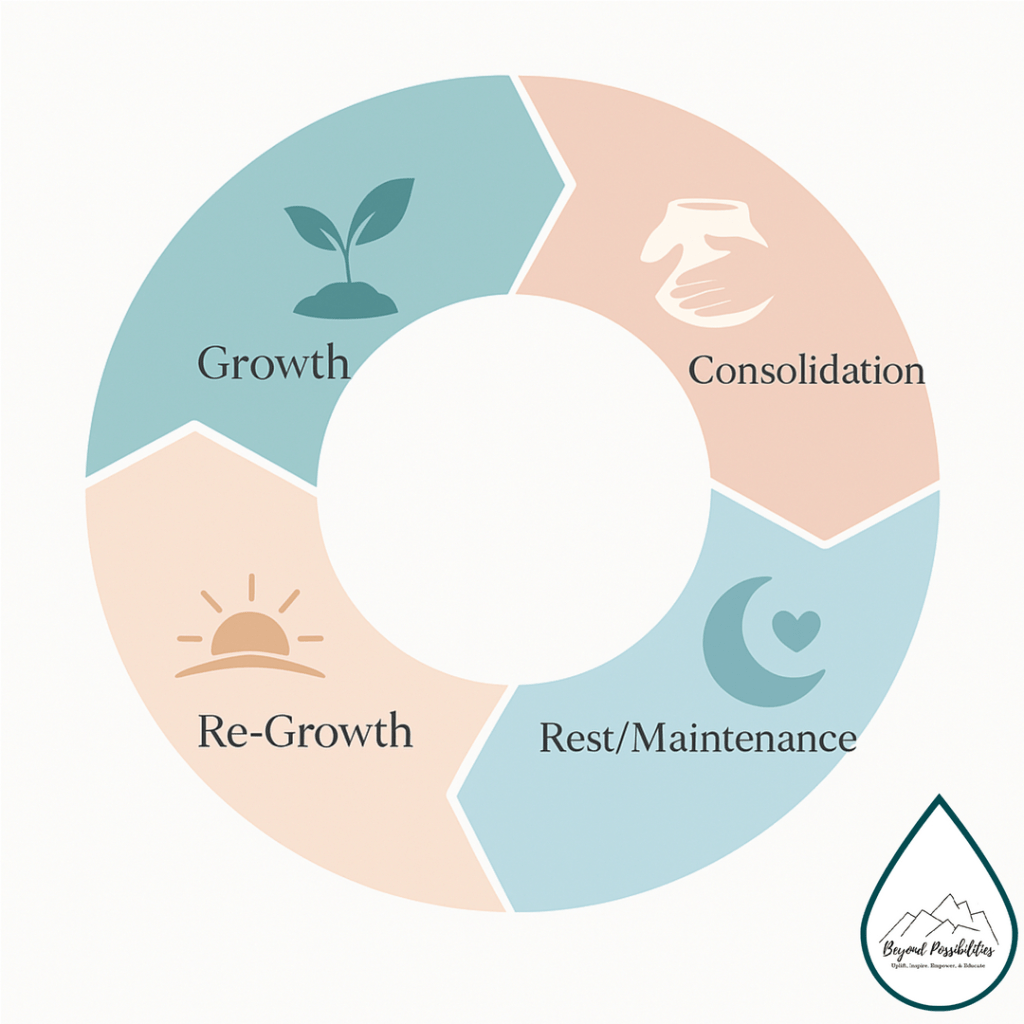
Growth becomes sustainable when we intentionally cycle through learning, reflection, and renewal. Here’s how to make that rhythm work for you:
Plan a Growth Block:
Start by choosing a clear, measurable goal that stretches you. It could be completing a major course, earning a certification, or building a wellness practice. During this time, dedicate focus and consistency—track your progress and celebrate effort as much as outcome. (Dweck, 2006; Schoenfeld et al., 2019).
Schedule a Consolidation Phase:
After a period of intense focus, shift into integration. Reflect on what you’ve learned and apply it to real-life experiences. For instance, I weave what I’m learning academically into my holistic coaching and educational work. This phase allows the brain to consolidate neural connections and solidify new habits (Diekelmann & Born, 2010; Marzola et al., 2023).
Take a Rest and Maintenance Season:
Prioritize recovery. Protect your sleep, connection, and self-care. This is not “losing momentum”—it’s giving your body and mind time to absorb and adapt. Chronic overextension increases stress load and decreases creativity (McEwen, 1998).
(This is also the area that I need to work on. Recovery, rest, and self-care are not selfish or lazy; they are necessary mentally, intellectually, spiritually, and physically.)
Repeat with Intention:
When your energy renews, begin the next growth cycle with purpose. Continual learning keeps your life vibrant and aligned. Every new goal builds upon the foundation of the last (Baltes et al., 1980).

Living in a State of Becoming
When we embrace a growth mindset, we see every season of life—whether it’s success, stillness, or struggle—as part of an evolving pattern. We’re not meant to stay in constant motion; we’re meant to grow, consolidate, rest, and rise again—wiser, steadier, and more aligned with who we’re becoming.
Continual learning isn’t just an academic goal—it’s a lifestyle of possibility.
I am excited to start applying this new awareness to my life, particularly in the areas of rest and recovery. As part of my next growth block, I am going to dive a little deeper into the Protective and Damaging Effects of Stress Mediators by Bruce S. McEwen, Ph.D. (McEwen, 1998).
References
Baltes, P. B., Reese, H. W., & Lipsitt, L. P. (1980). Life-span developmental psychology. Annual Review of Psychology, 31(1), 65–110. https://doi.org/10.1146/annurev.ps.31.020180.000433
Diekelmann, S., & Born, J. (2010). The memory function of sleep. Nature Reviews Neuroscience, 11(2), 114–126. https://doi.org/10.1038/nrn2762
Dweck, C. S. (2006). Mindset: The new psychology of success. Random House.
Marzola, E., et al. (2023). Neuroplasticity and learning: Integrating memory consolidation and behavioral change. Frontiers in Behavioral Neuroscience, 17, 112–128. https://doi.org/10.3389/fnbeh.2023.1102208
McEwen, B. S. (1998). Protective and damaging effects of stress mediators. New England Journal of Medicine, 338(3), 171–179. https://doi.org/10.1056/NEJM199801153380307
Schoenfeld, B. J., Grgic, J., & Krieger, J. W. (2019). How many times per week should a muscle be trained to maximize muscle hypertrophy? Sports Medicine, 49(7), 1337–1355. https://doi.org/10.1007/s40279-019-01175-1

 Beyond Possibilities